
2024-03-13
Which Drawer Slides Are Better?
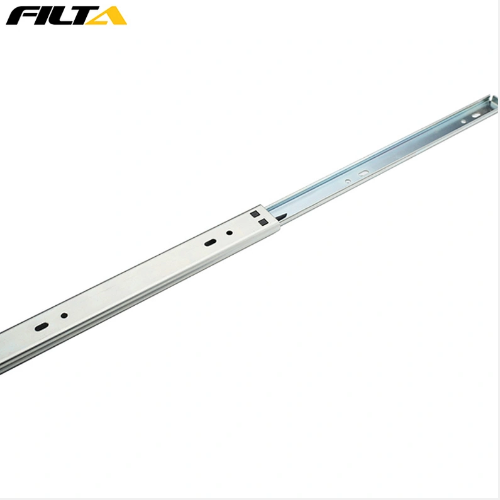
Drawer slides are essential for constructing drawers. Also referred to as drawer runners, these components are rails that enable drawers to extend outward from the furniture or structures in which they are installed. Drawers smoothly move or "slide" along these slides. While all drawer slides include lengthy rails, certain types incorporate rollers, while others utilize ball bearings.
There are two main types of drawer slides; roller slides and ball bearing slides. But which type of drawer slide should you choose? Which one is the best? Let’s check.
What Are Roller Drawer Slides?
Roller slides comprise two components, each equipped with its own roller, typically crafted from plastic. These rollers interlock within grooves present on the opposing member, positioned at opposite ends of the mechanism when fully compressed. Upon extension, the front roller facilitates outward movement of the upper member, while the rear roller trails within the groove of the lower member until both rollers converge. Roller drawer slides are commonly employed in household settings, such as desk drawers, where moderate loads and a horizontal orientation are anticipated.
What Are Ball Bearing Drawer Slides?
Ball bearing drawer slides utilize ball bearings instead of rollers to facilitate telescopic movement. Comprising three members, they incorporate two sets of ball bearings that interface between each member. During extension, the ball bearings enable smooth sliding between the members until fully expanded. These slides are employed across various applications, spanning from household fixtures like dresser drawers to industrial machinery. Additionally, there are heavy duty variants of ball bearing drawer slide tailored for harsher and more demanding environments.
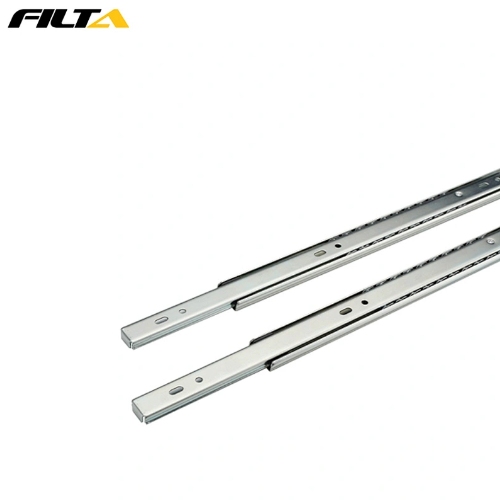
Differences Between Roller and Ball Bearing Drawer Slides
Here are several considerations to think when choosing various drawer slides. To identify the most suitable type, we'll analyze their designs and typical offerings for each category of drawer slide.
Load Rating
Load rating, or load capacity, denotes the maximum permissible weight or load that a drawer slide can support before experiencing failure. The ball bearing configuration of ball bearing slides enables them to accommodate significantly larger loads compared to roller slides. Roller slides typically have load ratings of less than 100lbs, whereas our cabinet ball bearing slides boast a rating of 400lbs, and our heavy-duty slides are rated for 500lbs.
Guide Rail Length
The guide rail length, also known as the stroke length, indicates the distance the drawer slide extends from fully retracted to fully extended. Roller slides typically feature a guide rail length of around 20 inches, whereas our cabinet ball bearing slides offer a maximum guide rail length of 50 inches, and our heavy duty ball bearing slides extend up to 60 inches. The design of ball bearing slides allows for longer guide rail lengths, providing a larger contact area between each member. This enhances the stability of ball bearing slides when fully extended, surpassing the stability achieved by the two contact points of roller slide designs.
Durability
In most cases, the stainless steel ball bearings utilized in ball bearing slides tend to be more durable than the plastic rollers found in roller slides. This discrepancy primarily stems from the inherent material properties of the two rolling elements. Stainless steel, being notably harder than plastic, exhibits superior resistance to wear and tear, thus ensuring a longer lifespan under similar loads.
Orientation
Due to their structural characteristics, roller slides are ideally suited for horizontal configurations and should only be affixed to the sides of drawers. This limitation arises because the rollers are not firmly secured within the grooves of each member, posing a risk of dislodgement if the orientation were to change. In contrast, ball-bearing slides offer greater versatility in orientation compared to roller slides, as the ball bearings are securely anchored within the grooves of each member. This allows ball bearing slides to be utilized in both horizontal and vertical arrangements. Additionally, some ball-bearing slides can even be mounted underneath the drawer, although it's essential to consult the manufacturer's specifications to ensure compatibility and to assess any potential impact on factors such as load rating.
PRODUCT KNOWLEDGE - March 10, 2026
Difference Between Passage and Privacy Lockset
Learn the difference between passage and privacy locksets. Discover how bathroom privacy lock handles improve interior door functionality.
March 05, 2026
Modern Keyless House Door Lock for Secure Residential Access
Learn about smart door entry system security protocols, digital door entry systems selection criteria, and installation compatibility factors.

PRODUCT KNOWLEDGE - February 28, 2026
Why Modern Electronic Keypad Door Lock Technology Matters to Businesses
Explore modern electronic keypad door lock solutions for commercial use, covering security standards, smart integration, and OEM supply insights for global buyers.