What Size Drawer Pulls to Use?
One of the most common—and consequential—questions during a kitchen, wardrobe, or furniture renovation is: “What size drawer pulls to use?” While hardware may seem like a minor detail, the drawer pull size you select directly impacts functionality, visual balance, and overall design cohesion. Too small, and the pull feels flimsy or gets lost on a large drawer; too large, and it overwhelms delicate cabinetry or interferes with adjacent doors.
Understanding Drawer Pull Size Guide Basics: Center-to-Center Measurements Explained
When professionals refer to drawer pull sizes, they’re almost always talking about the center-to-center (C-to-C) distance—the measurement between the centers of the two mounting holes. This standard, not the total length of the pull, determines compatibility with pre-drilled cabinetry.
Common drawer pull size guide benchmarks include:
76mm (≈3 inches) – ideal for small drawers, cabinet doors, or narrow wardrobe panels
128mm (≈5 inches) – a versatile mid-size for standard kitchen drawers and bathroom vanities
192mm (≈7.5 inches) – best suited for wide drawers, pantry doors, or statement pieces in luxury settings
These measurements aren’t arbitrary. They align with industry-standard drilling templates used by cabinetmakers worldwide. For example, Filta’s elegant gold fluted handle line offers all three sizes (76/128/192mm), ensuring compatibility with both European and North American cabinetry systems. This standardization allows designers to specify hardware confidently, knowing installation will be seamless.
It's also worth noting that the pull’s projection (how far it extends from the surface) and grip depth affect usability—but the C-to-C dimension remains the primary sizing factor for fit and proportion.

Matching Pull Size to Drawer Width: A Rule of Thumb for Balanced Design
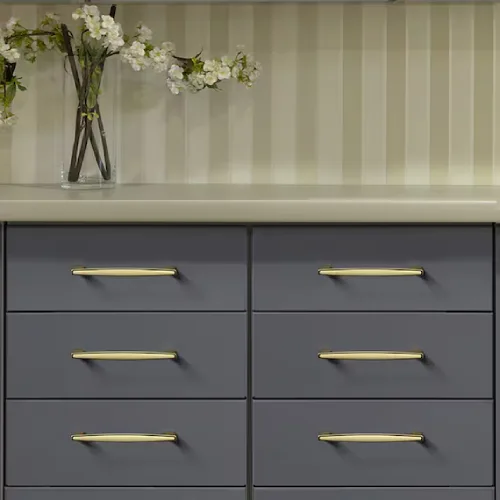
So, what size drawer pulls to use on a 24-inch drawer versus a 12-inch one? A widely accepted design principle suggests that the pull should span approximately one-third of the drawer’s width. This creates visual harmony without crowding the surface.
For instance:
A 12-inch (300mm) drawer pairs well with a 76mm or 128mm pull
An 18–24 inch (450–600mm) drawer typically calls for a 128mm or 192mm pull
Tall cabinet doors (e.g., pantry or wardrobe) often benefit from longer pulls (192mm) for easier access and vertical alignment
This proportional approach ensures that luxury drawer pulls—like fluted or textured designs—enhance rather than distract. A large, ornate pull on a tiny drawer can look awkward, while a petite knob on a wide appliance drawer may be impractical to grip.
Moreover, consistency matters. In open-plan kitchens or walk-in closets, using the same furniture drawer pulls size across similar drawer types creates rhythm and order. That said, strategic variation is acceptable—and sometimes desirable—when function dictates it (e.g., smaller pulls on spice drawers, larger ones on base cabinets).
Can Cabinet Pulls Be Different Sizes? Navigating Mix-and-Match Strategies
Many homeowners wonder: “Can cabinet pulls be different sizes?” The short answer is yes—but with intention.
Mixing drawer pull sizes can add visual interest and signal functional hierarchy. For example, you might use 192mm pulls on lower kitchen drawers (for ease of access while standing) and 76mm pulls on upper cabinets or narrow appliance panels. In wardrobes, longer pulls on full-height doors contrast elegantly with compact knobs on internal drawers.
However, avoid random variation. To maintain cohesion:
Stick to the same finish (e.g., titanium gold or matte black) across all hardware
Use only 2–3 sizes max in a single room
Align pulls vertically or horizontally where possible to create visual lines
Brands like Filta support this flexibility by offering identical designs—such as their elegant gold fluted handle—in multiple C-to-C sizes. This allows designers to scale the same aesthetic across diverse cabinetry without compromising on style or quality. The result? A curated, intentional look that feels custom, not chaotic.
Practical Considerations: Installation, Screws, and Compatibility
Beyond aesthetics, the right drawer pull size must also be practical to install and durable in use. Even the most beautiful luxury drawer pulls will underperform if they don’t come with proper hardware or fit existing drill holes.
Key practical factors include:
Included screws: High-quality pulls typically include two 4×22mm (or 8/32” 1”) stainless steel screws, which resist corrosion and provide secure mounting. Filta’s products, for example, include these standard fasteners across all sizes.
Pre-drilled cabinets: If your cabinetry is already drilled, match the C-to-C measurement exactly—there’s little room for error.
Projection and grip: Ensure the pull extends far enough from the surface to allow comfortable finger clearance, especially for users with limited dexterity.
Additionally, consider packaging and handling. Premium furniture drawer pulls are often individually poly-bagged to prevent scratches during shipping—a small detail that preserves finish integrity until installation.
For large projects, supply reliability matters too. Manufacturers with high output capacity (e.g., 2 million pieces per month) can fulfill bulk orders without batch inconsistencies, ensuring every pull—whether 76mm or 192mm—looks and performs identically.