Should Drawer Slides Be Longer or Shorter Than the Drawer?
One of the most frequent—and consequential—questions in cabinetmaking, furniture design, and industrial storage setup is: “Should drawer slides be longer or shorter than the drawer?” The answer directly impacts smooth operation, load stability, longevity, and even safety. Yet many DIYers and even professionals get this wrong, leading to binding drawers, uneven wear, or premature hardware failure.
1. Should Drawer Slides Be Longer or Shorter Than the Drawer? Understanding the Core Principle
The short answer: Drawer slides should typically be slightly shorter than the drawer depth—but matched to the cabinet interior depth, not the drawer box itself.
Here's why: Drawer slides mount between the cabinet side wall and the drawer side. The usable slide length is determined by the inside depth of the cabinet, minus clearance for the back panel, mounting brackets, and front overlay. The drawer box is then built to match the slide's extension length—not the other way around.
For example, in a cabinet with a 22-inch interior depth, you'd typically install an 18-inch or 20-inch slide. The drawer box would then be built to 18 or 20 inches deep to align with the slide's travel. If you mistakenly choose a slide longer than the cabinet allows, it won't fit. If it's too short, you lose valuable storage space and may compromise load distribution.
This principle becomes even more critical with heavy drawer runners. Under high loads, a slide that's too short concentrates stress near the front mounting points, increasing the risk of sagging or bracket pull out. Conversely, a properly sized slide ensures the load is distributed along the full bearing surface.

2. How Slide Length Affects Performance: Full Extension, Load Balance, and Structural Integrity
The relationship between slide length and performance goes beyond fit—it influences three key factors:
Full vs. Partial Extension: Most modern applications, especially in kitchens and workshops, demand full-extension slides, which allow the drawer to open completely. These require precise length matching: the slide length should equal the usable cabinet depth. A mismatch means you either can't access the back of the drawer or the slide binds against the cabinet rear.
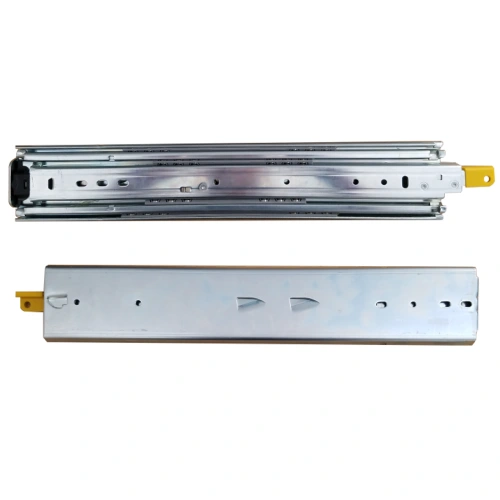
Load Distribution: With heavy duty runners, especially those rated for 200+ pounds, a longer slide provides more ball bearing contact area, reducing point stress and minimizing deflection. For instance, Filta's 53mm wide heavy duty metal drawer slides are engineered with extended raceways that maximize support over the full travel—something only possible when the slide length is correctly matched to the cabinet.
Mounting Stability: Shorter slides may seem easier to install, but they offer less rear support. In deep drawers loaded with tools, cookware, or electronics, this can cause the drawer front to droop over time. Properly sized slides anchor securely at both front and rear, maintaining alignment through thousands of cycles.
In industrial settings—such as server racks, medical carts, or garage storage—where heavy drawer runners carry dense, uneven loads, even a 1–2 inch deviation in slide length can lead to operational issues or safety concerns.
3. Practical Sizing Guidelines for Different Applications: Kitchen, Workshop, and Industrial Use
Choosing the right slide length depends on your use case:
Residential Kitchens: Standard base cabinets have 22–24 inch interior depths. Use 18-inch, 20-inch, or 22-inch full-extension slides. For pull-out pantries or appliance garages, ensure the slide length matches the cabinet—not the drawer front.
Workshops & Garages: Drawers often hold heavy, irregular items. Opt for heavy duty runners with lengths that maximize cabinet depth usage (e.g., 24-inch slides in 26-inch cabinets). The extra bearing length improves stability under off-center loads.
Industrial & Commercial: In tool carts or storage units, slide length must account for vibration, frequent cycling, and safety margins. Many drawer runners suppliers offer custom lengths, but standard sizes (16", 18", 20", 22", 24") cover most needs. Always verify the actual cabinet interior—not just the nominal size.
When working with heavy duty metal drawer slides, also consider the slide's profile width. Wider rails (like Filta's 53mm series) offer greater torsional rigidity, which complements proper length selection to prevent wobble or binding in wide drawers.
Pro tip: Measure twice—once for cabinet interior depth (front to back, inside the frame), and once for desired drawer box depth. Subtract 1/2 to 1 inch for rear clearance, then select the nearest standard slide length.
4. Frequently Asked Questions About Drawer Slide Length and Sizing
Q: Should drawer slides be longer or shorter than the drawer box?
A: Slides should be the same length as the drawer box depth, and both should be slightly shorter than the cabinet interior to allow for mounting clearance.
Q: Can I use a shorter slide to save money?
A: Technically yes, but you'll sacrifice storage access and load stability—especially with heavy items. It's a false economy in high-use or heavy-load applications.
Q: What if my cabinet depth doesn't match standard slide lengths?
A: Most drawer runners suppliers offer common sizes (16"–24"). If you're off by an inch, you can often adjust with mounting brackets or spacer blocks—but avoid forcing a mismatch.
Q: Do heavy duty runners require different length rules?
A: The sizing principle is the same, but heavy drawer runners benefit more from maximum possible length to distribute high loads evenly and reduce stress on mounting hardware.
Q: How do I measure for replacement slides?
A: Remove the old slide and measure its extended length (not retracted). Alternatively, measure the cabinet interior depth and subtract 1 inch for clearance.