How Much Weight Can Drawer Slides Hold?
When homeowners, cabinetmakers, or industrial designers search “how much weight can drawer slides hold?” they're often at a critical decision point—choosing hardware that balances functionality, safety, and longevity. The answer isn't as simple as a single number; it depends on slide type, mounting method, material quality, and application context. From sleek kitchen cabinets to industrial tool carts, understanding the true load capacity of heavy duty slide rails is essential to avoid sagging drawers, mechanical failure, or even safety hazards.
1. Understanding Drawer Slide Load Ratings: What “Weight Capacity” Really Means
The advertised weight capacity of a drawer slide—often listed as “100 lbs,” “250 lbs,” or even “1,000 lbs”—refers to the dynamic load rating: the maximum weight the slide can support while being opened and closed repeatedly over its expected lifespan (typically 50,000+ cycles under test conditions). This is different from a static load rating, which measures how much weight the slide can hold when stationary.
However, this rating assumes ideal installation: perfectly level mounting, full-length support, and even weight distribution. In reality, uneven loads (e.g., a heavy power tool placed at the front of a workshop drawer) or misaligned cabinets can reduce effective capacity by 30% or more.
Drawer slides fall into three general categories by load capacity:
Light duty (up to 75 lbs): Common in residential furniture and office drawers.
Medium duty (75–150 lbs): Used in standard kitchen cabinets and bathroom vanities.
Heavy duty (150–1,000+ lbs): Found in commercial kitchens, industrial workbenches, server racks, and garage storage systems.
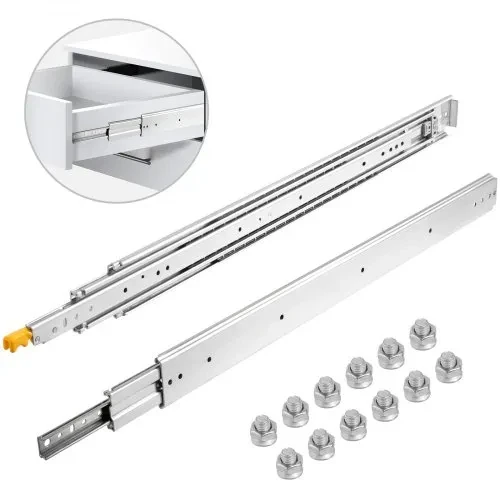
Heavy duty slide rails, like the 53mm-wide models engineered for high-load applications, are typically constructed from cold-rolled steel with reinforced ball-bearing mechanisms. Their wider profile (53mm vs. standard 35–45mm) increases structural rigidity, reducing deflection under load—a key factor in long-term reliability.

2. Factors That Influence Real-World Weight Capacity Beyond the Label
While a drawer slide supplier may advertise a 500-lb capacity, several real-world variables can affect actual performance:
Mounting Surface Integrity: Slides mounted into particleboard or thin plywood may fail before the slide itself does. Solid wood or metal frames provide superior anchoring.
Slide Length and Extension Type: Full-extension slides distribute load more evenly than partial-extension models. Longer slides (e.g., 24 inches vs. 16 inches) also handle heavier loads more effectively due to increased bearing surface area.
Number of Slides per Drawer: Most drawers use two slides (left and right), so the total system capacity is double the per-slide rating—assuming perfect balance. Adding a third (center) slide can further enhance stability for wide or deep drawers.
Environmental Conditions: Humidity, temperature swings, and exposure to chemicals (e.g., in labs or garages) can degrade lubricants or corrode components, especially in non-stainless or non-coated steel slides.
Usage Frequency: A drawer opened 10 times a day in a home kitchen experiences far less stress than one cycled hundreds of times daily in a hospital or factory setting. High-cycle applications demand higher-grade heavy duty kitchen drawer slides with hardened raceways and precision bearings.
Manufacturers like Filta address these variables by designing slides with reinforced brackets, pre-lubricated ball bearings, and corrosion-resistant finishes—features that support consistent performance even under demanding conditions.
3. Choosing the Right Heavy Duty Slide for Your Application: Kitchen, Workshop, or Industrial Use
Selecting the appropriate slide isn't just about matching a weight number—it's about aligning hardware with use case.
In residential kitchens, even “heavy-duty” typically means 100–150 lbs capacity. But with the rise of pull out pantries, appliance garages, and deep base cabinets, demand for 200+ lb slides is growing. Heavy duty kitchen drawer slides now often include soft-close mechanisms and full extension for ergonomic access—without sacrificing strength.
In workshops or garages, drawers may hold power tools, batteries, or metal stock, easily exceeding 250 lbs. Here, 53mm-wide heavy duty slide rails with steel construction and positive-locking features prevent accidental opening during movement or vibration.
For industrial or commercial settings—such as server rooms, medical carts, or manufacturing tooling stations—slides must meet stringent durability and safety standards. Load capacities of 500–1,000 lbs are common, often with certifications for fire resistance, ESD safety, or seismic stability.
When sourcing from a drawer slide supplier, ask about:
Test standards used (e.g., ANSI/KCMA, ISO)
Material thickness (gauge of steel)
Bearing type (ball vs. roller)
Availability of mounting hardware and adjustment features
Companies that specialize in high-performance hardware, such as Filta, often publish detailed technical specs—not just marketing claims—enabling informed decisions based on engineering, not aesthetics alone.
4. Frequently Asked Questions About Drawer Slide Weight Capacity
Q: How much weight can standard kitchen drawer slides hold?
A: Most residential slides support 75–100 lbs. For heavier loads (e.g., cookware or appliances), upgrade to heavy-duty models rated for 150–250 lbs or more.
Q: Do heavy duty slide rails really hold 1,000 lbs?